Choose the answer that fits you best most of the time, not the one you think you should choose. It takes about four minutes. Your answers stay in your browser: nothing is stored or sent.
Your result
Your answers are spread almost evenly between two groups. Read both profiles below and see which one feels closer.
The Analyst (NT)
Logic, strategy and independent thinking
You look for the logic behind things, think in long lines and are not easily impressed by authority alone. You want to understand before you act.
At your best
- Seeing patterns and long-term consequences that others overlook.
- Solving complex problems with clear, independent thinking.
- Questioning weak arguments and improving how things are done.
Where a toxic boss can get to you
- Attacks on your judgment. A boss who keeps telling you that you have “misunderstood” can make you doubt the very thing you rely on most: your thinking. This is how gaslighting works on capable people.
- Arguing with someone who is not interested in arguments. You may try to win with logic. With a manipulative boss, that costs energy and can get you labeled as difficult.
- Ignoring your own warning signals. You may dismiss stress, anger or unease as “irrational” and notice too late how much the situation is affecting you.
How to protect yourself
- Turn your analysis into evidence: write down facts, dates and decisions (Chapter 5).
- Treat your body’s stress signals as data, not noise (Chapter 4, Trusting Your Instincts; Chapter 8).
- Choose your battles. Not every illogical decision is worth a fight (Chapter 5, When Confronting Your Boss Might Not Be a Good Idea).
The Diplomat (NF)
Empathy, values and connection
You sense what is going on between people, care about meaning and fairness and often hold a team together. Your values guide your decisions.
At your best
- Building trust and understanding what motivates people.
- Mediating conflicts and seeing several perspectives.
- Creating a supportive team climate and a sense of purpose.
Where a toxic boss can get to you
- Guilt and emotional pressure. Guilt-tripping works on you because you feel responsible for how others feel.
- Keeping the peace at your own expense. The wish for harmony can make you avoid necessary conflict and accept more than you should (Chapter 3, Are You a People Pleaser?).
- Looking for the good intention. You may keep searching for the reason behind behavior that is simply harmful, and give a manipulative boss one chance too many.
How to protect yourself
- Practice saying no without long explanations, and set boundaries early (Chapters 7 and 9).
- Examine beliefs such as “If I disappoint someone, I am not a good person” (Chapter 6).
- Separate empathy from responsibility: you can understand your boss without having to fix them (Chapter 9).
The Sentinel (SJ)
Reliability, structure and duty
You are the person others can count on. You value clear rules, keep your commitments and make sure that standards and deadlines are met.
At your best
- Delivering reliably, with care and attention to detail.
- Creating order, processes and stability in a team.
- Keeping commitments and holding others to fair standards.
Where a toxic boss can get to you
- Loyalty that keeps you too long. Your sense of duty can keep you in a toxic role long after it has started to harm you.
- Respect for hierarchy. You may assume that the boss is right and look for the mistake in yourself first.
- Reliability that gets exploited. You may become the one who quietly absorbs extra work, and perfectionism makes it worse (Chapter 7, Are You a Perfectionist Yourself?).
How to protect yourself
- Remember that rules apply to leaders too. Use the formal channels: documentation, HR, escalation (Chapter 5).
- Watch for over-responsibility and perfectionism (Chapter 7).
- Decide in advance what you will not accept, so you recognize the line when it is crossed. The workplace checklist helps.
The Explorer (SP)
Action, adaptability and resourcefulness
You are at your best when something needs to happen now. You adapt quickly, stay calm in a crisis and prefer doing to talking.
At your best
- Reacting quickly and staying calm when things go wrong.
- Finding practical solutions and improvising under pressure.
- Bringing energy, flexibility and momentum to a team.
Where a toxic boss can get to you
- Control and micromanagement. Constant control hits you especially hard. If you react impulsively, a manipulative boss can use it against you as “unprofessional”.
- Patterns that go unnoticed. Because you deal with problems as they come, a pattern of manipulation can grow for a long time before you see it as a whole.
- No paper trail. You may skip documentation and planning, and then lack evidence and options when you need them.
How to protect yourself
- Build in a pause before you react. A short delay protects you from being provoked (Chapters 9 and 10).
- Keep a simple log of incidents. A few notes over time reveal patterns (Chapters 4 and 5).
- Think through your options before you need them, so you can act instead of react (Chapter 5).
No personality type protects you from manipulation, and none makes you responsible for it. Manipulation says something about the person who uses it. Knowing your type helps you see earlier where you are easy to reach, and which of your strengths you can rely on.
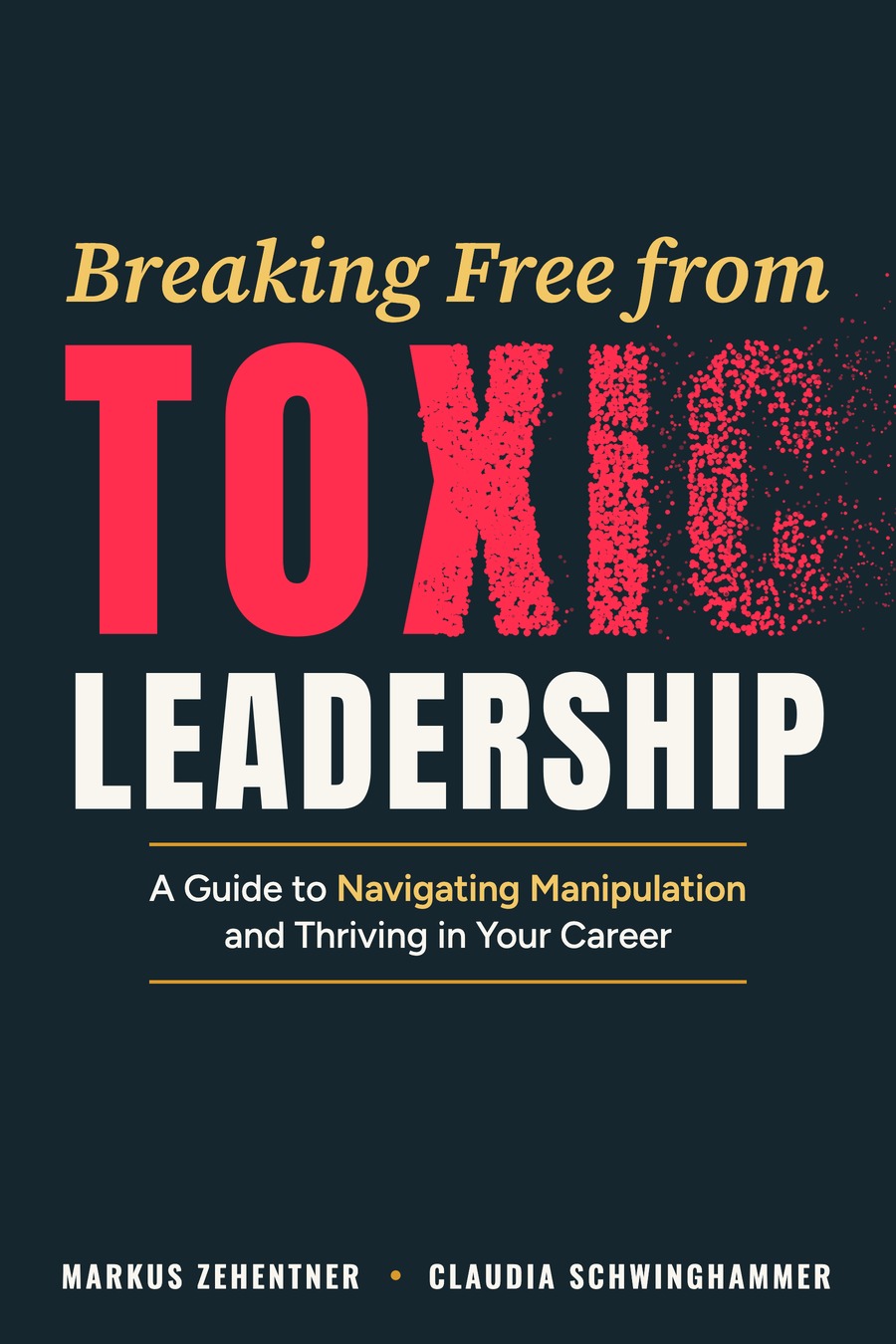
Want to go deeper? The bonus chapter on Jung’s personality types describes all four groups in detail and shows how to work with colleagues of each type. Chapter references point to Breaking Free from Toxic Leadership.
Have you broken free from a toxic boss, or found a way to protect yourself? Share your story and help other readers.
About this self-check. It is a reflection tool based on Carl Jung’s psychological types and the four groups described in our bonus chapter (Analysts, Diplomats, Sentinels, Explorers). It is not a validated psychological test and not the official Myers-Briggs Type Indicator® (MBTI®). Research favors trait models such as the Big Five for measuring personality, and type results can change when you take a test again. Use your result as a starting point for reflection, not as a label.